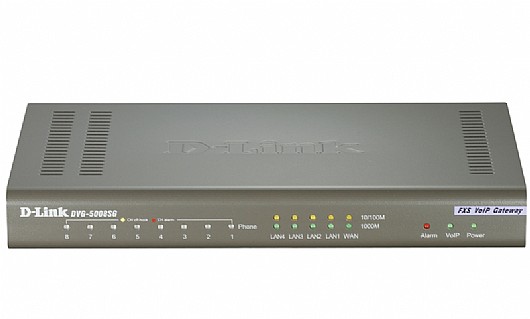
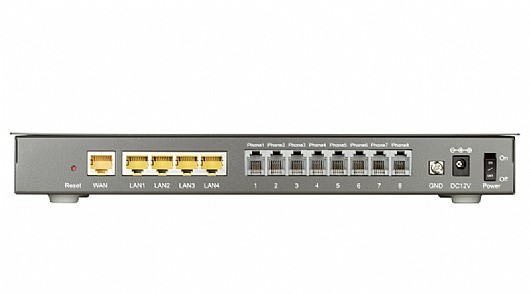
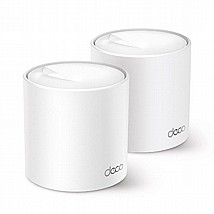
Physical interfaces
• WAN: 1 port 10/100/1000 Mb / s Ethernet
• LAN: 4 x 10/100/1000 Mbit / s Ethernet
• Ports Phone: 8-port FXS (RJ-11)
• Button Reset: Returns to the default settings
• Button Power: on / off switch power
Software features
Voice Features
• G.722, G.711 a / u-law, G.723.1, G.726, G.729A / B, GSM 6.10 Full Rate, iLBC13, 3 kbit / s
• DTMF detection and generation
• Detect and silence suppression
• Comfort Noise Generation (CNG)
• Voice Activity Detection (VAD)
• Echo cancellation (G.165/G.168)
• Variable (dynamic) jitter-buffer
• Generate tone CPT (Call Progress Tone)
• Automatic or programmable gain
• Integrated local frequency converter
• Supports ITU-T V.152
Phone functions
• In-Band DTMF, Out-of-Band DTMF Relay (RFC2833 and SIP INFO)
• Support for DTMF / Pulse
• Detection / Generation Caller ID (Caller ID):
- DTMF
- FSK-Bellcore Type 1 and 2
- FSK-ETSI Type 1 and 2
- FSK-NTT
- FSK: caller's name, number, date and time, vMWI
• billed pulses at port FXS:
- Detection of reverse polarity
- Tonal range of 12 kHz
- Tonal range of 16 kHz
• Generation (FXS) tone PSTN
• T.30 FAX Bypass, T.38 Real Time FAX Relay
• Working modem connection via V.34
• Signal ROH (Receiver Off-Hook, @ 480 Hz)
• Loop Current Suppression
• Diagnostic and testing lines FXS with visual indication of errors
• Incoming calls:
- Loopback-codec
- Loopback-analogue
- Voltage SLIC
- Wire a / b powered by DC
- Incoming call
• Outgoing calls (Standard GR909):
- REN
- Disconnect
- Danger high voltage direct current
- Danger high voltage AC
- Wire a / b short
SIP-supported methods
• ACK
• BYE
• CANCEL
• INFO
• INVITE
• MESSAGE
• NOTIFY
• OPTIONS
• PING
• PRACK
• PUBLISH
• REFER
• REGISTER
SIP-calls
• Calls «Peer-to-Peer»
• Hold
• Call waiting / call return
• Call Pickup
• Parking / call return (requires SIP-server)
• Call forwarding (unconditional, busy, no answer)
• Call transfer (with and without announcement)
• "Do not disturb"
• Speed dialing
• Redial
• Three-way conference
• MWI (RFC-3842)
• Hot Line and Warm Line
Call Management
• Support for outbound proxy
• Up to three SIP-server
• Re-registration for SIP-server authorization fails
• The group call
• Privacy Mechanism / Private Extensions to SIP
• Session Timers (Update / Re-invite)
• Support for DNS SRV
• The types of calls: Voice / Modem / Fax
• Call Routing prefix
• Support for user-programmable dial plan
• CDR-client
• Create a manual recording (for calls P2P)
• Support for ENUM and E.164 numbering standard
Manage Accounts
• Registration for the port-based
• Registration for the core of the device (general account)
• Mixed mode register (Hunt number for incoming calls, based on the port number for outgoing calls)
• Invite with Challenge
• Registration for the IP-address or domain name server SIP-
• Supports RFC3986 SIP URI
IP specification
• Support for IPv4, IPv6
• WAN: Static IP, PPPoE, DHCP, PPTP
• Supports network protocols: IP, TCP, UDP, TFTP, FTP, RTP, RTCP, ARP,
RARP, ICMP, NTP, SNTP, SNMP v1/v2/v3, HTTP, HTTPS, DNS, DNS SRV,
Telnet, DHCP-server , DHCP-client, STUN-Client, UPnP, IGMP snooping,
IGMP proxy
• Support for QoS:
- WAN: DiffServ, IP Precedence, priority queues, Rate Control, 802.1Q (VLAN Tagging), 802.1p (Priority Tag)
- LAN: Speed Limit
• Support DDNS
- Dyndns.org, TZO and Peanut Hull
Network Security
• VPN PPTP-client
• Authentication DIGEST
• MD5 Encryption
• Protection against DoS attacks
Management
• Web-interface
• Auto-provisioning (HTTP / HTTPS)
• Telnet
• IVR
• Software upgrade via FTP / TFTP / HTTP
• Backup and restore settings
• The Reset button to reset to the default settings
• TR-069/104 (optional)
• SNMP V3 / V2c / V1
Standards SIP, Voice and FAX
• RFC1889 RTP: A Transport Protocol for Real-Time Applications
• RFC2543 SIP: Session Initiation Protocol
• RFC2833 RTP Payload for DTMF Digits, Telephony Tones and Telephony Signals
• RFC2880 Internet Fax T.30 Feature Mapping
• RFC2976 The SIP INFO Method
• RFC3261 SIP: Session Initiation Protocol
• RFC3262 Reliability of Provisional Responses in Session Initiation Protocol (SIP)
• RFC3263 Session Initiation Protocol (SIP): Locating SIP Servers
• RFC3264 An Offer / Answer Model with Session Description Protocol (SDP)
• RFC3265 Session Initiation Protocol (SIP)-Specific Event Notification
• RFC3311 The Session Initiation Protocol (SIP) UPDATE Method
• RFC3323 A Privacy Mechanism for the Session Initiation Protocol (SIP)
• RFC3325 Private Extensions to the SessionInitiation Protocol (SIP) for Asserted Identity within Trusted Networks
• RFC3362 Real-time Facsimile (T.38) -image/t38 MIME Sub-type Registration
• RFC3515 The Session Initiation Protocol (SIP) Refer Method
• RFC3550 RTP: A Transport Protocol for Real-Time Applications. July 2003
• RFC3665 Session Initiation Protocol (SIP) Basic Call Flow Examples
• RFC3824 Using E.164 numbers with the Session Initiation Protocol (SIP)
• RFC3841 Caller Preferences for the Session Initiation Protocol (SIP)
• RFC3842 A Message Summary and Message Waiting Indication Event Package for the Session Initiation Protocol (SIP)
• RFC3891 The Session Initiation Protocol (SIP) "Replaces" Header
• RFC3892 The Session Initiation Protocol (SIP) Referred-By Mechanism
• RFC3960 Early Media and Ringing Tone Generation in the Session Initiation Protocol (SIP)
• RFC3986 Uniform Resource Identifier (URI): Generic Syntax
• RFC4028 Session Timers in the Session Initiation Protocol (SIP)
• Draft-ietf-sipping-service-examples-08 for call features
Network Standards
• RFC318 Telnet Protocols
• RFC791 Internet Protocol
• RFC792 Internet Control Message Protocol
• RFC793 Transmission Control Protocol
• RFC768 User Datagram Protocol
• RFC826 Ethernet Address Resolution Protocol
• RFC959 File Transfer Protocol
• RFC1034 Domain Names-concepts and facilities
• RFC1035 Domain Names-implementation and specification
• RFC1058 Routing Information Protocol
• RFC1157 Simple Network Management Protocol (SNMP)
• RFC1305 Network Time Protocol (NTP)
• RFC1321 The MD5 Message-Digest Algorithm
• RFC1349 Type of Service in the Internet Protocol Suite
• RFC1350 The TFTP Protocol (Revision 2)
• RFC1661 The Point-to-Point Protocol (PPP)
• RFC1738 Uniform Resource Locators (URL)
• RFC2854 The 'text / html' Media Type
• RFC2131 Dynamic Host Configuration Protocol
• RFC2136 Dynamic Updates in the Domain Name System (DNS UPDATE)
• RFC2327 SDP: Session Description Protocol
• RFC2474 Definition of the Differentiated Services Field (DS Field)
• RFC2516 A Method for Transmitting PPP Over Ethernet
• RFC2616 Hypertext Transfer Protocol -HTTP/1.1
• RFC2617 HTTP Authentication: Basic and Digest Access Authentication
• RFC2637 Point-to-Point Tunneling Protocol
• RFC2766 Network Address Translation-Protocol Translation (NAT-PT)
• FC2782 A DNS RR for Specifying the location of Sevices (DNS SRV)
• RFC2818 HTTP Over TLS (HTTPS)
• RFC2916 E.164 Number and DNS
• RFC3022 Traditional IP Network Address Translator
• RFC3489 STUN-Simple Traversal of User Datagram Protocol (UDP) Through Network Address Translators (NATs)
Measurements
• 28,7 x 16 x 3,6 cm
Weight
• 1300 g
Power
• Input: 100 to 240 VAC, 50/60 Hz
• Output: 12 V DC, 2 A
Temperature
• Operating: -10 to 45 ° C
• Storage: -25 to 75 ° C
Humidity
• Operating: 0% to 90% (non-condensing)
• Storage: 0% to 95% (non-condensing)
Certificates
• Approvals EMI: FCC part15 B, CE class B
• Safety Approvals: CE / LVD