| Processor |
• RTL9607C (900MHz) |
| RAM |
• 256MB, DDR3, built in processor |
| Flash |
• 128MB, SPI NAND |
| Interfaces |
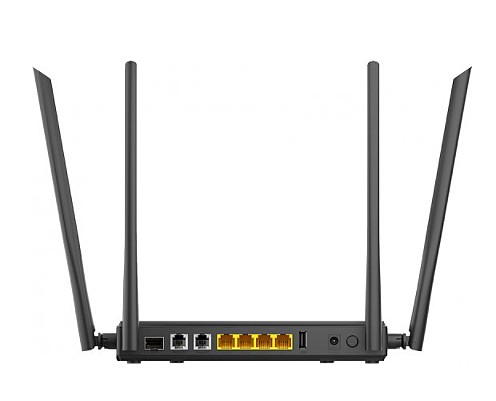
• 1000BASE-X SFP WAN port
• 4 10/100/1000BASE-T LAN ports
• 2 RJ-11 FXS ports
• USB 2.0 port
|
| LEDs |
• Power
• SFP
• Internet
• LAN 1-4
• WLAN 2.4G/5G
• WPS
• USB
• FXS 1-2
|
| Buttons |
• ON/OFF button to power on/power off
• RESET button to restore factory default settings
• WLAN button to enable/disable wireless network
• WPS button to set up wireless connection
|
| Antenna |
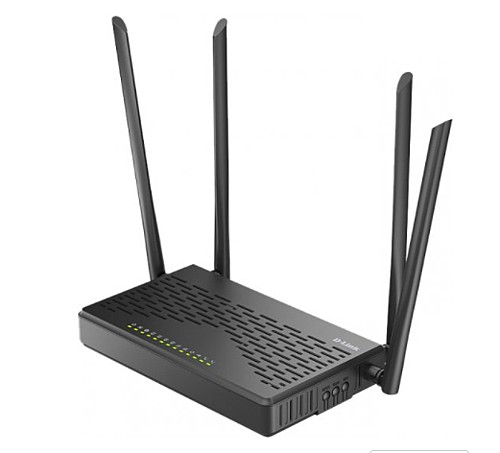
• Four external non-detachable antennas (5dBi gain) |
| MIMO |
• 2 x 2, MU-MIMO |
| Power connector |
• Power input connector (DC) |
| Software |
| WAN connection types |
• Mobile Internet
• PPPoE
• IPv6 PPPoE
• PPPoE Dual Stack
• Static IPv4 / Dynamic IPv4
• Static IPv6 / Dynamic IPv6
• PPTP/L2TP
• Bridge
|
| Network functions |
• DHCP server/relay
• Advanced configuration of built-in DHCP server
• Stateful/Stateless mode for IPv6 address assignment, IPv6 prefix delegation
• Automatic obtainment of LAN IP address (for access point/repeater/client modes)
• DNS relay
• Dynamic DNS
• Static IPv4/IPv6 routing
• IGMP Proxy
• RIP
• Support of UPnP IGD
• Support of VLAN
• WAN ping respond
• Support of SIP ALG
• Support of RTSP
• WAN failover
• LAN/WAN conversion
• Autonegotiation of speed, duplex mode, and flow control / Manual speed and duplex mode setup for each Ethernet port
• Built-in UDPXY application
• XUPNPD plug-in
• Equal load distribution while using several WAN connections (traffic balancing)
|
| Firewall functions |
• Network Address Translation (NAT)
• Stateful Packet Inspection (SPI)
• IPv4/IPv6 filter
• MAC filter
• URL filter
• Ad blocking function
• DMZ
• Virtual servers
• Built-in Yandex.DNS web content filtering service
• Built-in SkyDNS web content filtering service |
| VPN |
• IPsec/PPTP/L2TP/PPPoE pass-through
• PPTP/L2TP tunnels
• L2TP over IPsec
• GRE tunnels, EoGRE tunnels
• IPsec tunnels
Transport/Tunnel mode
IKEv1/IKEv2 support
DES encryption
NAT Traversal
Support of DPD (Keep-alive for VPN tunnels)
|
| USB interface functions |
• USB modem
- Auto connection to available type of supported network (4G/3G/2G)
- Auto configuration of connection upon plugging in USB modem
- Enabling/disabling PIN code check, changing PIN code1
- Sending/receiving/reading/removing SMS messages1
- Support of USSD requests1
• USB storage
File browser
Print server
Access to storage via accounts
Built-in Samba/FTP/DLNA server
Built-in Transmission torrent client; uploading/downloading files from/to USB storage
|
| Management and monitoring |
• Local and remote access to settings through SSH/TELNET/WEB (HTTP/HTTPS)
• Multilingual web-based interface for configuration and management
• Support of D-Link Assistant application for Android and iPhone smartphones
• Notification on connection problems and auto redirect to settings
• Firmware update via web-based interface
• Automatic notification on new firmware version
• Saving/restoring configuration to/from file
• Support of logging to remote host/connected USB storage
• Automatic synchronization of system time with NTP server and manual time/date setup
• Ping utility
• Traceroute utility
• TR-069 client
• Schedules for filters rules, automatic reboot, and enabling/disabling wireless network
• Automatic upload of configuration file from ISP's server (Auto Provision)
|
| Wireless Module Parameters |
| Standards |
• IEEE 802.11a/n/ac
• IEEE 802.11b/g/n
• IEEE 802.11w
|
|
Frequency range
The frequency range depends upon the radio frequency regulations applied in your country
|
• 2400 ~ 2483.5MHz
• 5150 ~ 5350MHz
• 5650 ~ 5850MHz
|
| Wireless connection security |
• WEP
• WPA/WPA2 (Personal/Enterprise)
• Latest SAE with 128-bit AES encryption
• МАС filter
• WPS (PBC/PIN)
|
| Advanced functions |
• Support of client mode
• WMM (Wi-Fi QoS)
• Information on connected Wi-Fi clients
• Advanced settings
• Guest Wi-Fi / support of MBSSID
• Rate limitation for wireless network
• Periodic scan of channels, automatic switch to least loaded channel
• Support of 2.4GHz/5GHz TX Beamforming
• Autonegotiation of channel bandwidth in accordance with environment conditions (20/40 Coexistence)
• Support of STBC
|
| Wireless connection rate |
• IEEE 802.11a: 6, 9, 12, 18, 24, 36, 48, and 54Mbps
• IEEE 802.11b: 1, 2, 5.5, and 11Mbps
• IEEE 802.11g: 6, 9, 12, 18, 24, 36, 48, and 54Mbps
• IEEE 802.11n (2.4GHz/5GHz): from 6.5 to 300Mbps (from MCS0 to MCS15)
• IEEE 802.11ac (5GHz): from 6.5 to 867Mbps (from MCS0 to MCS9)
|
|
Transmitter output power
The maximum value of the transmitter output power depends upon the radio frequency regulations applied in your country
|
• 802.11a (typical at room temperature 25 °C)
15dBm at 6, 9, 12, 18, 24, 36, 48, 54Mbps
• 802.11b (typical at room temperature 25 °C)
15dBm at 1, 2, 5.5, 11Mbps
• 802.11g (typical at room temperature 25 °C)
15dBm at 6, 9, 12, 18, 24, 36, 48, 54Mbps
• 802.11n (typical at room temperature 25 °C)
2.4GHz, HT20/HT40
15dBm at MCS0~7
5GHz, HT20/HT40
15dBm at MCS0~7
• 802.11ac (typical at room temperature 25 °C)
VHT20/VHT40/VHT80
15dBm at MCS0~9
|
| Receiver sensitivity |
• 802.11a (typical at PER < 10% at room temperature 25 °C)
-82dBm at 6Mbps
-81dBm at 9Mbps
-79dBm at 12Mbps
-77dBm at 18Mbps
-74dBm at 24Mbps
-70dBm at 36Mbps
-66dBm at 48Mbps
-65dBm at 54Mbps
• 802.11b (typical at PER = 8% at room temperature 25 °C)
-82dBm at 1Mbps
-80dBm at 2Mbps
-78dBm at 5.5Mbps
-76dBm at 11Mbps
• 802.11g (typical at PER < 10% at room temperature 25 °C)
-82dBm at 6Mbps
-81dBm at 9Mbps
-79dBm at 12Mbps
-77dBm at 18Mbps
-74dBm at 24Mbps
-70dBm at 36Mbps
-66dBm at 48Mbps
-65dBm at 54Mbps
|
| |
• 802.11n (typical at PER = 10% at room temperature 25 °C)
2.4GHz/5GHz, HT20
-82dBm at MCS0
-79dBm at MCS1
-77dBm at MCS2
-74dBm at MCS3
-70dBm at MCS4
-66dBm at MCS5
-65dBm at MCS6
-64dBm at MCS7
2.4GHz/5GHz, HT40
-79dBm at MCS0
-76dBm at MCS1
-74dBm at MCS2
-71dBm at MCS3
-67dBm at MCS4
-63dBm at MCS5
-62dBm at MCS6
-61dBm at MCS7
• 802.11ac (typical at PER = 10% at room temperature 25 °C)
VHT20
-82dBm at MCS0
-79dBm at MCS1
-77dBm at MCS2
-74dBm at MCS3
-70dBm at MCS4
-66dBm at MCS5
-65dBm at MCS6
-64dBm at MCS7
-56dBm at MCS8
VHT40
-79dBm at MCS0
-76dBm at MCS1
-74dBm at MCS2
-71dBm at MCS3
-67dBm at MCS4
-63dBm at MCS5
-62dBm at MCS6
-61dBm at MCS7
-56dBm at MCS8
-54dBm at MCS9
VHT80
-76dBm at MCS0
-73dBm at MCS1
-71dBm at MCS2
-68dBm at MCS3
-64dBm at MCS4
-60dBm at MCS5
-59dBm at MCS6
-58dBm at MCS7
-53dBm at MCS8
-51dBm at MCS9
|
| Modulation schemes |
• 802.11a: BPSK, QPSK, 16QAM, 64QAM with OFDM
• 802.11b: DQPSK, DBPSK, DSSS, CCK
• 802.11g: BPSK, QPSK, 16QAM, 64QAM with OFDM
• 802.11n: BPSK, QPSK, 16QAM, 64QAM with OFDM
• 802.11ac: BPSK, QPSK, 16QAM, 64QAM, up to 256QAM with OFDM
|
| Phone |
| General SIP Features |
• Support of several SIP profiles
• Individual account per port
• Invite with Challenge
• Register by IP address or domain name of SIP server
• Backup proxy support
• Support of DHCP option 120
• RFC3986 SIP URI format support
• Outbound proxy support
• STUN client
• NAT public IP address
· NAT keep-alive
• Session timer (re-invite/update)
• Call types: voice/modem/fax
• User programmable Dial Plan
• Manual peer table (for P2P calls)
• Handling numbers in E.164 format
|
| Call Features |
• Direct IP-to-IP сall without SIP proxy (P2P)
• Call hold/retrieve
• Call awaiting
• Forwarding (unconditional, busy, no answer)
• Do Not Disturb
• Anonymous call blocking
• Speed/abbreviated dialing
• PIN code before dialing
• Hotline
• Vertical service codes
• CLIR
• Intercom (internal calls without SIP server)
• Filtering SIP packets by IP address/domain name (white/black list)
• Logging and recording calls
• Sending text messages to VoIP gateways/IP phones
|
| Voice Features |
• Codecs: G.711 a/μ-law, G.729A, G.726, G.722, G.723.1, GSMFR, ILBC
• DTMF detection and generation
• In-band DTMF, out-of-band DTMF (RFC2833, SIP-INFO)
• Comfort Noise Generation (CNG)
• Voice Activity Detection (VAD)
• Dynamic Jitter Buffer
• Echo Cancellation (LEC/NLP)
• Call progress tone generation (FXS)
• DTMF/PULSE dial support
• Caller ID detection and generation
• T.30 FAX bypass to G.711, T.38 Real Time FAX Relay, V.152
• Adjustable Flash Time
• Advanced call transfer
• Volume control (speaker/microphone)
|
| Physical Parameters |
| Dimensions (L x W x H) |
• 206 x 123 x 32 mm (8.1 x 4.8 x 1.3 in) |
| Weight |
• 330 g (0.73 lb) |
| Operating Environment |
| Power |
• Output: 12V DC, 1.5A |
| Temperature |
• Operating: from 0 to 40 °C
• Storage: from -20 to 65 °C
|
| Humidity |
• Operating: from 10% to 90% (non-condensing)
• Storage: from 5% to 95% (non-condensing)
|
| Delivery Package |
|
• Router DVG-5402G/GF
• Power adapter DC 12V/1.5A
• Ethernet cable
• RJ-11 telephone cable
• “Quick Installation Guide” (brochure)
|
|
Supported USB modems2
|
| GSM |
• Alcatel X500
• D-Link DWM-152C1
• D-Link DWM-156A6
• D-Link DWM-156A7
• D-Link DWM 156A8
• D-Link DWM-156C1
• D-Link DWM-157B1
• D-Link DWM-157B1 (Velcom)
• D-Link DWM-158D1
• D-Link DWR-710
• Huawei E150
• Huawei E1550
• Huawei E156G
• Huawei E160G
• Huawei E169G
• Huawei E171
• Huawei E173 (Megafon)
• Huawei E220
• Huawei E3131 (MTS 420S)
• Huawei E352 (Megafon)
• Prolink PHS600
• Prolink PHS901
• ZTE MF112
• ZTE MF192
• ZTE MF626
• ZTE MF627
• ZTE MF652
• ZTE MF667
• ZTE MF668
• ZTE MF752
|
| LTE |
• Alcatel IK40V
• D-Link DWM-222
• Huawei E3131
• Huawei E3272
• Huawei E3351
• Huawei E3372s/E3372h-153
• Huawei E367
• Huawei E392
• Megafon M100-1
• Megafon M100-2
• Megafon M100-3
• Megafon M100-4
• Megafon M150-1
• Megafon M150-2
• Quanta 1K6E (Beeline 1K6E)
• MTS 824F
• MTS 827F
• Yota LU-150
• Yota WLTUBA-107
• ZTE MF823
• ZTE MF827
|
| Smartphones in USB tethering mode |
• Some models of Android smartphones |